 cashd
cashdBaseball Cards
Resale value
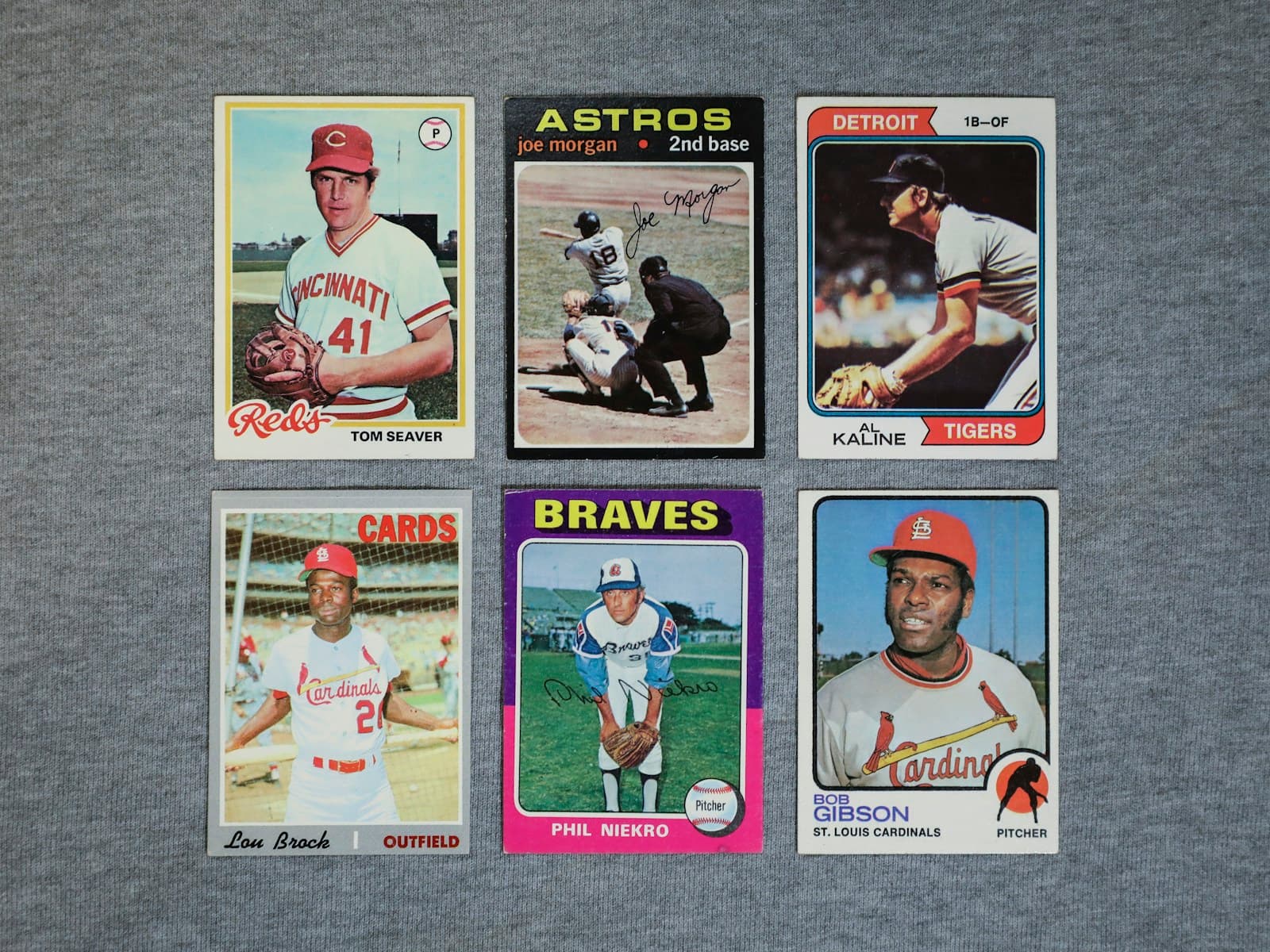
There's no single "typical" baseball card price — a '90s common is worth cents and a vintage Mantle is worth a fortune. Scan your card in Cashd to price the exact player, set, and condition against current eBay listings.
Priced item by item. Scan yours for a price on your exact item.
Most-Searched Baseball Cards by Player
The players whose cards drive the market, from vintage legends to today's stars. Base versions are far more affordable than graded, parallel, or autographed copies.
- Mickey Mantle1952 Topps #311 is the hobby's most famous post-war card; his 1951 Bowman is the true rookie.
- Babe Ruth & Honus Wagner1933 Goudey Ruth and the T206 Wagner — pre-war grails that are almost never in ordinary collections.
- Jackie Robinson & Hank Aaron1948 Leaf Robinson and 1954 Topps Aaron — key vintage rookies, value driven by condition.
- Ken Griffey Jr.1989 Upper Deck #1 — the defining junk-wax-era rookie; high grades are where the money is.
- Derek Jeter1993 SP Foil rookie — hard to find in top condition, which drives graded prices.
- Mike Trout2011 Topps Update is the mainstream rookie; the 2009 Bowman Chrome prospect autograph is the high-end card.
- Shohei Ohtani2018 Topps and Topps Chrome Update rookies — his two-way play keeps demand strong.
- Aaron Judge2017 Topps rookies — steady demand tied to his home run records.
- Juan Soto & Paul SkenesModern stars — Soto's 2018 rookies and Skenes' 2024 cards are active, performance-driven markets.
- Cal Ripken Jr.1982 Topps Traded rookie — a popular '80s key card.
- Junk wax era (1987–1994)Topps, Donruss, Fleer, Score, and Upper Deck from these years were overproduced. Pull out the key rookies; the rest usually sell by the box.
What moves the price
- 01
Vintage cards (pre-1980) of Hall of Famers hold the most value — condition matters enormously at that age.
- 02
Rookie cards drive modern prices — a player's first Topps, Topps Chrome, or Bowman Chrome card is what collectors want.
- 03
Bowman Chrome prospect cards and autographs can be worth more than a player's later "official" rookie card.
- 04
Grade multiplies value for anything valuable; for common cards it isn't worth the fee.
- 05
Parallels (Refractors, numbered colors) are separate, pricier cards than the base version.
- 06
1987–1994 "junk wax" cards were overproduced — most sell only in bulk lots.
The full story
Baseball has the oldest and deepest card market of any sport — from pre-war legends like Babe Ruth and Honus Wagner to today's stars like Shohei Ohtani and Aaron Judge. Value comes from the player, the specific card, and condition, with vintage cards (pre-1980) and modern star rookies carrying most of the money.
The biggest surprise for most people clearing out a collection: cards from roughly 1987–1994 were printed in such huge numbers that almost all of them are worth very little, even stars. The exceptions — a few key rookies in top condition — are worth pulling out. Scan yours in Cashd to price your exact card against current eBay sales.
Questions
Are my old baseball cards worth anything?
If they're from the late '80s or early '90s, most aren't — they were printed in the millions. Look for key rookies (Ken Griffey Jr.'s 1989 Upper Deck, Derek Jeter's 1993 SP) and anything pre-1980 in good condition. Scan a few in Cashd to find the ones worth selling.
Is the Ken Griffey Jr. 1989 Upper Deck rookie worth money?
Raw copies usually sell for modest amounts because so many exist; high-grade PSA 10 copies are where the real money is.
What makes a vintage baseball card valuable?
The player (Mantle, Ruth, Aaron, Robinson), the year (rookies especially), and condition — corners, centering, creases, and surface. A creased copy can be worth a fraction of a clean one.
How does Cashd price my baseball card?
Cashd identifies the player and card from your photo and prices it against current comparable eBay listings, rather than a generic category guess.
Got a Baseball Cards?
Snap it and get a price for your exact one.
Cashd may earn a commission from eBay links on this page. Prices are market data, not an appraisal.